Posts

Complexity Digest

Gottfried Mayer died last January 25th, after more than a year of fighting with cancer. I've taken his position as editor of Complexity Digest . I will try to keep up the standards that Gottfried set. We will miss him.

W. Ross Ashby Digital Archive

The W. Ross Ashby Digital Archive has been recently launched. Ashby was one of the most prominent Cyberneticians . His work has been only recently rediscovered, which includes great contributions to the study of the brain, systems, adaptation, and self-organization. He has been an inspiration for my work on self-organizing systems . The digital archive includes Ashby's journal, biographies, pictures, bibliography, a few letters (I didn't know that he was acquainted with Turing ...), and aphorisms (one of my weak spots (in need of an update)). A couple of them that I liked especially: A "system" is a set of variables sufficiently isolated to stay [constant] long enough for us to discuss it. Science is the Observer's Digest.

Traffic work featured in IEEE intelligent systems

Work I did together with Seung Bae Cools was featured in the November/December 2008 issue of IEEE Intelligent Systems: The second story, "Autonomous Agents Take On City Driving," reports on current uses of AI technology to improve urban traffic flow. See the full text here (click on PDF on the right). You can find details of this work on Chapter 5 of my PhD thesis .

Single World Currency?

I was wondering the other day: what would happen if there was a single currency throughout the world? Who would benefit? Who would lose? Is it a sensible idea? It seems to have been good for the Euro zone, but there are not that many disparities between the member states. Searching a bit online, I quickly found: http://www.singleglobalcurrency.org/ http://en.wikipedia.org/wiki/World_currency http://www.vanguardonline.f9.co.uk/0614.htm So it is an interesting idea, but will it be worth the effort?

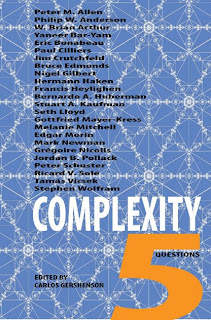
New Book: Complexity: 5 Questions

Image
This volume consists of short, interview-style contributions by leading figures in the field of complexity, based on five questions. The answers trace their personal experience and expose their views on the definition, aspects, problems and future of complexity. The aim of the book is to bring together the opinions of researchers with different backgrounds on the emerging study of complex systems. In this way, we will see similarities and differences, agreements and debates among the approaches of different schools. Contributors: Peter M. Allen, Philip W. Anderson, W. Brian Arthur, Yaneer Bar-Yam, Eric Bonabeau, Paul Cilliers, Jim Crutchfield, Bruce Edmonds, Nigel Gilbert, Hermann Haken, Francis Heylighen, Bernardo A. Huberman, Stuart A. Kauffman, Seth Lloyd, Gottfried Mayer-Kress, Melanie Mitchell, Edgar Morin, Mark Newman, Grégoire Nicolis, Jordan B. Pollack, Peter Schuster, Ricard V. Solé, Tamás Vicsek, Stephen Wolfram. Get it at Amazon.com Check out more books from the 5 Questions s...

Go Obama!

Why people should vote for Obama ? Well, better the other way around: the only reason I can think of for people not voting for him is racism. A few months ago, I went to a doctor. He had been a pilot in WWII, made his way up the hard way, complained about the American youth. When I told that I hoped that Obama would be the next U.S. president, he was amazed: "What have black people done for this country?!". I was puzzled and amazed. I won't attempt to answer his question here (Michael Jackson?). He continued: "we need someone like McCain, to protect us from the Russians." One could think that the age of the doctor would explain his anti-Russian sentiment, but actually it is quite generalized, after almost 20 years of the end of the cold war. On the one hand, Russians have better things to do than to "threaten" the USA. On the other hand, there are much more dangers for the U.S. citizens coming from within, starting with incompetent leaders and ending ...

New Paper: The Sigma Profile: A Formal Tool to Study Organization and its Evolution at Multiple Scales

The Sigma Profile: A Formal Tool to Study Organization and its Evolution at Multiple Scales Abstract : The σ profile is presented as a tool to analyze the organization of systems at different scales, and how this organization changes in time. Describing structures at different scales as goal-oriented agents, one can define σ ("satisfaction") as the degree to which the goals of each agent at each scale have been met. σ reflects the organization degree at that scale. The σ profile of a system shows the satisfaction at different scales, with the possibility to study their dependencies and evolution. It can also be used to extend game theoretic models. A general tendency on the evolution of complexity and cooperation naturally follows from the σ profile. Experiments on a virtual ecosystem are used as illustration. [ Full paper ]