Posts

Showing posts with the label technology

Paper published: Deliberative Self-Organizing Traffic Lights with Elementary Cellular Automata
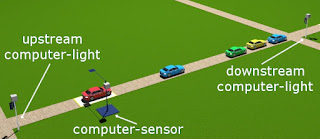
Image
Self-organizing traffic lights have shown considerable improvements compared to traditional methods in computer simulations. Self-organizing methods, however, use sophisticated sensors, increasing their cost and limiting their deployment. We propose a novel approach using simple sensors to achieve self-organizing traffic light coordination. The proposed approach involves placing a computer and a presence sensor at the beginning of each block; each such sensor detects a single vehicle. Each computer builds a virtual environment simulating vehicle movement to predict arrivals and departures at the downstream intersection. At each intersection, a computer receives information across a data network from the computers of the neighboring blocks and runs a self-organizing method to control traffic lights. Our simulations showed a superior performance for our approach compared with a traditional method (a green wave) and a similar performance (close to optimal) compared with a self-organizing ...

Improving Urban Mobility by Understanding its Complexity

Urban mobility systems are composed multiple elements with strong interactions, i.e. their future is co-determined by the state of other elements. Thus, studying components in isolation, i.e. using a reductionist approach, is inappropriate. I propose five recommendations to improve urban mobility based on insights from the scientific study of complex systems: use adaptation over prediction, regulate interactions to avoid friction, use sensors to recover real time information, develop adaptive algorithms to exploit that information, and deploy agents to act on the urban environment. Improving Urban Mobility by Understanding its Complexity Carlos Gershenson http://arxiv.org/abs/1603.04267

Paper published: Measuring the complexity of adaptive peer-to-peer systems

To improve the efficiency of peer-to-peer (P2P) systems while adapting to changing environmental conditions, static peer-to-peer protocols can be replaced by adaptive plans. The resulting systems are inherently complex, which makes their development and characterization a challenge for traditional methods. Here we propose the design and analysis of adaptive P2P systems using measures of complexity, emergence, self-organization, and homeostasis based on information theory. These measures allow the evaluation of adaptive P2P systems and thus can be used to guide their design. We evaluate the proposal with a P2P computing system provided with adaptation mechanisms. We show the evolution of the system with static and also changing workload, using different fitness functions. When the adaptive plan forces the system to converge to a predefined performance level, the nodes may result in highly unstable configurations, which correspond to a high variance in time of the measured complexity. Co...

Winners of the Audi Urban Future Award 2014

On November 10th, a day after the 25th anniversary of the fall of the Berlin wall , our team Living Mobilities from Mexico City was declared winner of the third edition of the Audi Urban Future Award . Together with José Castillo (team leader, watch the video from his final presentation ) from Arquitectura 911 and Gabriella Gómez-Mont from the Laboratorio para la Ciudad , we were proud and delighted to be declared winners by an international jury , considering the great proposals presented by the teams from Berlin, Boston, and Seoul. Audi Urban Future Award 2014 - Data collectors from Mexico City win the Award 2014 from THE AUDI URBAN FUTURE INITIATIVE on Vimeo . Our project proposes to create a new social contract, assisted by technology, to improve mobility not only in terms of efficiency, but also in terms of quality of life. This focusses on Mexico City, but has the potential to be extended to other megacities in Latin America, Asia, and Africa. We have a big city wi...

New draft: Requisite Variety, Autopoiesis, and Self-organization

Ashby's law of requisite variety states that a controller must have at least as much variety (complexity) as the controlled. Maturana and Varela proposed autopoiesis (self-production) to define living systems. Living systems also require to fulfill the law of requisite variety. A measure of autopoiesis has been proposed as the ratio between the complexity of a system and the complexity of its environment. Self-organization can be used as a concept to guide the design of systems towards higher values of autopoiesis, with the potential of making technology more "living", i.e. adaptive and robust. Requisite Variety, Autopoiesis, and Self-organization Carlos Gershenson Invited keynote at WOSC 2014 http://arxiv.org/abs/1409.7475

New Essay Published: Harnessing the complexity of education with information technology

Education at all levels is facing several challenges in most countries [1-4], such as low quality, high costs, lack of educators, and unsatisfied student demand. Traditional approaches are becoming unable to deliver the required education. Several causes for this inefficiency can be identified. I argue that beyond specific causes, the lack of effective education is related to complexity [5, 6]. However, information technology is helping us overcome this complexity. Complexity can be measured with information theory and can be seen as the balance between stability and variability [7-10]: phenomena without change or with constant change cannot exhibit complex behavior. It has been noted that to actively control a complex system, the controller has to be at least as complex as the controlled [11, 12]. For example, a successful healthcare provider has to match the complexity of the patients she attends. Treatment is highly specific for different patients, so a general practitioner must ha...

Paper published: Measuring the Complexity of Self-Organizing Traffic Lights

We apply measures of complexity, emergence, and self-organization to an urban traffic model for comparing a traditional traffic-light coordination method with a self-organizing method in two scenarios: cyclic boundaries and non-orientable boundaries. We show that the measures are useful to identify and characterize different dynamical phases. It becomes clear that different operation regimes are required for different traffic demands. Thus, not only is traffic a non-stationary problem, requiring controllers to adapt constantly; controllers must also change drastically the complexity of their behavior depending on the demand. Based on our measures and extending Ashby’s law of requisite variety, we can say that the self-organizing method achieves an adaptability level comparable to that of a living system. Zubillaga, Darío; Cruz, Geovany; Aguilar, Luis D.; Zapotécatl, Jorge; Fernández, Nelson; Aguilar, José; Rosenblueth, David A.; Gershenson, Carlos. 2014. "Measuring the Complexit...

Video: Application of living technology to urban problems

Image
Earlier this month I gave a seminar back at the VUB, one of my alma maters. Here is a video recording, more details here  or below. Application of living technology to urban problems   Carlos Gershenson  (Universidad Nacional  Autónoma de México)  Abstract: I will present an overview of current and potential applications of living technology to urban problems. Living technology can be described as technology that exhibits the core features of living systems. These features can be useful to solve dynamic problems. In particular, urban problems concerning mobility, logistics, telecommunications, governance, safety, sustainability, and society and culture are presented, while solutions involving living technology are reviewed. A methodology for developing living technology is mentioned, while supraoptimal public transportation systems are used as a case study to illustrate the benefits of urban living technology. Finally, the usefulness of de...

TED@SãoPaulo talk on Living Cities

Last June I had the privilege to participate in a wonderful evening in São Paulo where local TEDx organizers from all over Brazil gathered to attend TED's worldwide talent search . There were extremely interesting and moving 6 minute talks from a very broad range of themes and topics. I gave a talk on our work on Living Cities and their potential for solving urban problems. There were almost 300 talks in 14 cities worldwide. 20 of those will be selected to present in TED2013. TED@SãoPaulo was the only event held in Latin America, and I am the only Mexican competing for a place in TED2013. Please watch, rate, comment, and share my talk before August 31st, to help the organizers decide: http://talentsearch.ted.com/video/Carlos-Gershenson-Bringing-urba;TEDSao-Paulo You can find related work at http://arxiv.or­g/abs/1111.3659 http://dx.doi.­org/10.1371/jour­nal.pone.0021469 http://dx.plos.­org/10.1371/jour­nal.pone.0007292

Paper Published: Self-Organizing System-on-Chip Design

Self-organization in the context of computing systems refers to a technological approach to deal with the increasing complexity associated with the deployment, maintenance, and evolution of such systems. The terms self-organizing and autonomous are often used interchangeably in relation to systems that use organic principles (self-configuration, self-healing, and so on) in their design and operation. In the specific case of system on chip (SoC) design, organic principles are clearly in the solution path for some of the most important challenges in areas like logic organization, data movement, circuits, and software. In this article, we start by providing a definition of the concept of self-organization as it applies to SoCs, explaining what it means and how it may be applied. We then provide a survey of the various recent papers, journal articles, and books on the subject and close by pointing out possible future directions, challenges and opportunities for self-organizing SoCs. De ...

TEDxDF talk: Semáforos auto-organizantes

Last November I had the honor of participating in TEDxDF with a talk on self-organizing traffic lights. You can watch the video (in Spanish) at: http://tedxtalks.ted.com/video/TEDxDF-Carlos-Gershenson-Semfor  or  http://www.youtube.com/watch?v=QohrFmeNnVw Mejorar el transporte público de la Ciudad de México es una idea que a todos se nos ocurre, pero pocos hacemos algo al respecto. Este no es el caso de Carlos, un apasionado del estudio científico de la complejidad: ¿Cómo podemos diseñar componentes de un sistema para que, por medio de sus interacciones, realicen una función deseada a nivel del sistema? Con su ponencia Carlos responderá esta pregunta y expondrá ideas aplicables al DF para mejorar diversos medios de transporte, afectando positivamente la calidad de vida de la población.

New Draft: Living in Living Cities

This paper presents and overview of current and potential applications of living technology to urban problems. Living technology can be described as technology that exhibits the core features of living systems. These features can be useful to solve dynamic problems. In particular, urban problems concerning mobility, logistics, telecommunications, governance, safety, sustainability, and society and culture are presented, while solutions involving living technology are reviewed. Finally, the usefulness of describing cities as living systems is discussed. Gershenson, C. (2011). Living in Living Cities. C3 Report 2011.09.  http://arxiv.org/abs/1111.3659

Robocup

Today was the last day of competitions for my first RoboCup . Already on its 15th year, one of its goals is to have by 2050 human-size robots playing against the soccer world champions and winning. I thought that was far fetched, but after seeing some robots in action, it doesn't seem that impossible anymore. There are several different leagues, playing in simulations, wheeled and humanoid robots of different sizes. The simulated leagues can have complex strategies and make nice moves. Wheeled robots can move very fast and are very good at kicking. Team Water from China defeated TechUnited Eindhoven from The Netherlands in the final in an exciting 6-5. Those bots play good! At the human-robot match, Water tied 5-5 against an allowing group of team leaders. Humans could have easily won if they wished, but it was more of a friendly game... The humanoid robots are a bit slower, but still there is action packed excitement in some matches. The Nao robots are a bit slow, but they ca...

New Paper: Self-Organization Leads to Supraoptimal Performance in Public Transportation Systems

Gershenson C (2011) Self-Organization Leads to Supraoptimal Performance in Public Transportation Systems. PLoS ONE 6 (6): e21469.  http://dx.doi.org/10.1371/journal.pone.0021469 Abstract : The performance of public transportation systems affects a large part of the population. Current theory assumes that passengers are served optimally when vehicles arrive at stations with regular intervals. In this paper, it is shown that self-organization can improve the performance of public transportation systems beyond the theoretical optimum by responding adaptively to local conditions. This is possible because of a “slower-is-faster” effect, where passengers wait more time at stations but total travel times are reduced. The proposed self-organizing method uses “antipheromones” to regulate headways, which are inspired by the stigmergy (communication via environment) of some ant colonies.

Workshop on Self-Organizing Systems

Image
I am co-chairing the technical programme committe, together with Christian Bettstetter , IWSOS 2011, the Fifth International Workshop on Self-Organizing Systems, to be held on February, 23-25, 2011 in Karlsruhe, Germany. The general co-chairs are Martina Zitterbart and Hermann de Meer . Call for Papers will be distributed soon. Check the webpage at http://iwsos2011.tm.kit.edu

PhD thesis published: Design and Control of Self-organizing Systems: Facing Complexity with Adaptation and Self-organization

Image
My thesis was just published by LAP. This might be useful for anybody wanting a hardcopy of it. If you prefer printing it or reading electronically, it is still available here . Gershenson, C. (2010). Design and Control of Self-organizing Systems: Facing Complexity with Adaptation and Self-organization . LAP. Summary : Complex systems are usually difficult to design and control. There are several particular methods for coping with complexity, but there is no general approach to build complex systems. In this book I propose a methodology to aid engineers in the design and control of complex systems. This is based on the description of systems as self-organizing. Starting from the agent metaphor, the methodology proposes a conceptual framework and a series of steps to follow to find proper mechanisms that will promote elements to find solutions by actively interacting among themselves. A general introduction to complex thinking is given, while practical notions of complexity and self-...

SlideShare

This seems like a great site for sharing your slides... http://www.slideshare.net/ Conference organizers can upload the slides of their event to increase its impact... Should upload the ones of my talks and my course .

Paper Published: Why Does Public Transport Not Arrive on Time? The Pervasiveness of Equal Headway Instability

Gershenson C, Pineda LA (2009) Why Does Public Transport Not Arrive on Time? The Pervasiveness of Equal Headway Instability. PLoS ONE 4 (10): e7292. doi: 10.1371/journal.pone.0007292 Abstract Background The equal headway instability phenomenon is pervasive in public transport systems. This instability is characterized by an aggregation of vehicles that causes inefficient service. While equal headway instability is common, it has not been studied independently of a particular scenario. However, the phenomenon is apparent in many transport systems and can be modeled and rectified in abstraction. Methodology We present a multi-agent simulation where a default method with no restrictions always leads to unstable headways. We discuss two methods that attempt to achieve equal headways, called minimum and maximum . Since one parameter of the methods depends on the passenger density, adaptive versions—where the relevant parameter is adjusted automatically—are also put forward. Our res...

Google Scholar Metrics?

I wonder why Google Scholar has not implemented some metrics of scientific productivity equivalent to the popular ISI impact factor , which is used by most institutions and funding agencies to measure the qualifications of researchers. There are many problems with the impact factor, one of them being that it covers about 10% of published work. Google Scholar has a much broader database (although some of it needs polishing, since data was harvested automatically), and it would be great if they could implement at least some of these 39 measures . Well, scHolar index already does some...

New Swimming World Records: Technology or Training?

Yesterday was the final day of the World Swimming Championships in Rome . In the 40 swimming events, there were 43 new world records (Records were not set in every event, but in some events they were set several times between prelims, semifinals and finals). This is amazing and unprecedented. Many give credit to the new technology of swimsuits, which give swimmers a greater buoyancy. For this reason FINA is banning these swimsuits from next year, arguing that the swimsuits are helping swimmers as swimming enhancing technology. Some even say that the swimsuits are making a mockery of the sport , being it so easy to break a world record. In one of the finals, a swimmer made a time under the old world record, but was fifth place... Well, let us note that some swimmers, e.g. Phelps, Lochte, Peirsol, were not using the latest technology in swimsuits, and nevertheless they broke world records. It is not only the swimsuits. Also, should the swimsuits be really banned? It is a complicated qu...