Thursday, November 19, 2009

Artificial Life courses around the world

As a part of a new ALife workgroup, Tom Barbalet is putting together a list of ALife-related courses around the world. Quite an interesting exercise...

Tuesday, October 27, 2009

Paper Published: Why Does Public Transport Not Arrive on Time? The Pervasiveness of Equal Headway Instability

Gershenson C, Pineda LA (2009) Why Does Public Transport Not Arrive on Time? The Pervasiveness of Equal Headway Instability. PLoS ONE 4(10): e7292. doi:10.1371/journal.pone.0007292

Abstract

Background

The equal headway instability phenomenon is pervasive in public transport systems. This instability is characterized by an aggregation of vehicles that causes inefficient service. While equal headway instability is common, it has not been studied independently of a particular scenario. However, the phenomenon is apparent in many transport systems and can be modeled and rectified in abstraction.

Methodology

We present a multi-agent simulation where a default method with no restrictions always leads to unstable headways. We discuss two methods that attempt to achieve equal headways, called minimum and maximum. Since one parameter of the methods depends on the passenger density, adaptive versions—where the relevant parameter is adjusted automatically—are also put forward. Our results show that the adaptive maximum method improves significantly over the default method. The model and simulation give insights of the interplay between transport design and passenger behavior. Finally, we provide technological and social suggestions for engineers and passengers to help achieve equal headways and thus reduce delays.

Conclusions

The equal headway instability phenomenon can be avoided with the suggested technological and social measures.


Full paper at: http://dx.plos.org/10.1371/journal.pone.0007292

Wednesday, October 21, 2009

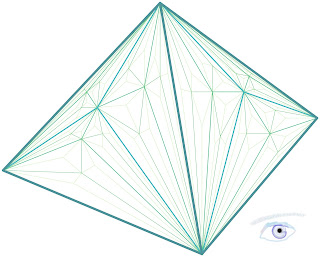
Fractal Projections:Tetrahedra


Fractal Projections:Tetrahedra by ~hawmkoonstormbringer on deviantART

I was a few weeks ago in Budapest for a conference on artificial life. I went to the Vasarely museum, and I liked a lot his perspective games, e.g. a sphere projected on a plane and cubes projected on the sphere. I thought that you could do this recursively, so you can project tetrahedra on the faces of tetrahedra, and this is the result...

This work is dedicated to the 30th birthday of my hopeful wife Nadya...

Monday, September 07, 2009

Google Scholar Metrics?

I wonder why Google Scholar has not implemented some metrics of scientific productivity equivalent to the popular ISI impact factor, which is used by most institutions and funding agencies to measure the qualifications of researchers. There are many problems with the impact factor, one of them being that it covers about 10% of published work. Google Scholar has a much broader database (although some of it needs polishing, since data was harvested automatically), and it would be great if they could implement at least some of these 39 measures. Well, scHolar index already does some...

Monday, August 03, 2009

New Swimming World Records: Technology or Training?

Yesterday was the final day of the World Swimming Championships in Rome. In the 40 swimming events, there were 43 new world records (Records were not set in every event, but in some events they were set several times between prelims, semifinals and finals). This is amazing and unprecedented.

Many give credit to the new technology of swimsuits, which give swimmers a greater buoyancy. For this reason FINA is banning these swimsuits from next year, arguing that the swimsuits are helping swimmers as swimming enhancing technology. Some even say that the swimsuits are making a mockery of the sport, being it so easy to break a world record. In one of the finals, a swimmer made a time under the old world record, but was fifth place...

Well, let us note that some swimmers, e.g. Phelps, Lochte, Peirsol, were not using the latest technology in swimsuits, and nevertheless they broke world records. It is not only the swimsuits.

Also, should the swimsuits be really banned? It is a complicated question. OK, the technology enhances swimming. But then should goggles be banned as well? They are technology. They were partially responsible for the 29 world records set in the Montreal Olympic games... (In Beijing last year, "only" 25 were broken...) And certainly, you don't want to allow all kinds of technology. I am not speaking about motors, of course, but fins or paddles... (well, that is why you have special championships to swim with fins and tanks...). But where to draw the boundary? I guess that everybody would agree that what needs to be regulated is that all swimmers compete in similar conditions, and the restrictions on the swim suits achieved that...

How much the world records depended on the swimsuits? We will see next year, when everybody will be competing without them: If they cannot make the same times, then the swimsuits are to blame. If they do, then it confirms that the improvement in the sport is due to better training, techniques, and understanding of fluid dynamics.

I believe that world records will still be broken, and those set in Rome will not last for a long time.

Monday, July 27, 2009

Book Review: Reinventing the Sacred, by Stuart A. Kauffman.

Gershenson, C. (2009). Book Review: "Reinventing the Sacred: A New View of Science, Reason, and Religion". Stuart A. Kauffman. Artificial Life 15(4):485-487

Excerpts: One of the main goals of this book is to demonstrate the inadequacy of reductionism in contemporary science. It does not negate its explanatory and predictive powers. It notes its limits, exploring several phenomena that are not predictable due to their complex nature. Thus, Kauffman argues, a shift in science is required if we want to understand these complex phenomena.

(...)

People might disagree with the answers that Kauffman puts forward. However, in my opinion the greatest contribution of this book, as with Platoʼs works, lies in the questions asked. It points out clearly which problems are currently relevant for science and society, even those that people are not aware of. Different tentative or partial solutions can be debated. However, the most difficult part is to start the discussion, and that is precisely what this book achieves.

(...)

I do not see the phenomena Kauffman discusses (evolution, economy, mind) as being “beyond science” just because they are not predictable. In a chaotic system, a future state might also be a “mystery.” However, its consideration is entirely scientific. Indeed, a change in the prevailing scientific assumptions must be made to explore these phenomena, but they can—and must—be studied within science. What we need to give up is the belief that phenomena are completely predictable.

Tuesday, July 14, 2009

New paper: Modeling self-organizing traffic lights with elementary cellular automata

Carlos Gershenson and David A. Rosenblueth, "Modeling self-organizing traffic lights with elementary cellular automata", C3 Report No. 2009.06.

Abstract: There have been several highway traffic models proposed based on cellular automata. The simplest one is elementary cellular automaton rule 184. We extend this model to city traffic with cellular automata coupled at intersections using only rules 184, 252, and 136. The simplicity of the model offers a clear understanding of the main properties of city traffic and its phase transitions.

We use the proposed model to compare two methods for coordinating traffic lights: a green-wave method that tries to optimize phases according to expected flows and a self-organizing method that adapts to the current traffic conditions. The self-organizing method delivers considerable improvements over the green-wave method. For low densities, the self-organizing method promotes the formation and coordination of platoons that flow freely in four directions, i.e. with a maximum velocity and no stops. For medium densities, the method allows a constant usage of the intersections, exploiting their maximum flux capacity. For high densities, the method prevents gridlocks and promotes the formation and coordination of "free-spaces" that flow in the opposite direction of traffic.

Full paper: http://arxiv.org/abs/0907.1925

Simulation available at: http://turing.iimas.unam.mx/~cgg/NetLogo/trafficCA.html

Wednesday, June 17, 2009

New Draft: What Does Artificial Life Tell Us About Death?

I just uploaded to the arXiv a first draft of a short essay "What Does Artificial Life Tell Us About Death?", you can download it at: http://arxiv.org/abs/0906.2824

Tuesday, June 09, 2009

Why Do Developing Countries Not Develop

After several years living abroad (St. Petersburg, Sussex, Brussels, Granada, Boston), it takes a bit of time to get used to life back in Mexico City.

Having some frame of comparison, I realized one way to describe the problem with developing countries such as Mexico: there is a high degree of incompetence.

Now, it is difficult to measure incompetence (In TeraBushes?), but to understand better what I mean, let us say that an agent (person, business, organization) is more incompetent if there are more tasks that the agent should perform successfully and it does not. I mean, I am quite incompetent in bureaucratic monotonous tedious labours, but these are not my duty (which some people refer to as "professional handwaving", others as "academia").

All countries and all agents have a certain degree of incompetence: nobody is perfect, there will always be errors, especially with novel tasks. Also, all countries and agents have a large degree of functionality, things that do work (somehow). However, in Mexico you run into incompetence across all scales more often than in other countries. Call it a higher error rate. To give an example, a couple of days ago I went to Home Depot to get some boards for some furniture I am making (another thing I am incompetent at...), and I was naïve enough not to check the boards at the shop. So, I start screwing^2 the boards together, and some of them aren't even square! Others have the wrong measures! I need to go back and return half the boards. OK, so Home Depot is a multinational company, and I suppose that you don't get this type of incompetence on all its locations. So, it is the error of the worker who chopped the boards.

Similar things happen every day: at restaurants you have a higher chance that the waiter will make an error with your order, our engineers have a higher chance of making an unusable bike track, our online banking systems have a higher chance of not working properly, our electricity has a higher chance of being interrupted, our presidents have a higher chance to make some silly agreement (and our congress of allowing it).

Where is the root of all this incompetence? I believe that we can say that in education. Countries which are less incompetent have much higher education rates. The average education in Mexico a few years back was five years per adult. This means that for each person with a PhD (~20 years of education), there are four with no education at all.

How can we improve education? This seems like a chicken and egg problem, because many teachers are quite incompetent (those who can, do; those who can't, teach...). And where do you get good teachers to teach teachers how to teach properly?

My opinion is that we need an alternative road to education, since it is too slow. It has improved, but it takes generations to make a difference. One option would be to increase awareness. If people are aware of their errors, they can try to correct them by themselves. If people are aware of the errors of others, they should complain (conformism and impunity are other big problems: errors are tolerated).

How to increase awareness? I would like to know, I need to increase mine. Meditation may help... I am sure that TV & church do not (we have >95% catholic population). Maybe a new online religion (read sect) combining scientific and oriental spiritual worldviews might do the trick...

Wednesday, June 03, 2009

Tentative Research Projects

I made a list of potential research projects I would like to explore with colleagues and/or students. You can find it here.